Urinary problems in children, causes, solutions and advice
Urinary problems are more common in children than you might think. Nevertheless, many parents are still unsure what to do about them. Should you immediately consider medication? Or should you start with a bedwetting alarm? When a child wets the bed, it is frustrating not just for the child, but for the entire family. Bedwetting can severely affect your child's self-confidence. The feeling of shame can lead to insecurity and even a negative self-image. It is important to take a child's problems seriously and to look for a suitable solution.

When is it considered a urinary problem in children?
Bedwetting is often only seen as a problem if a child still regularly wets the bed after the age of six. Until that age, it is usually a matter of time. Many children grow out of it on their own. But if it continues, it is good to take action. Not only for dry nights, but especially for your child's well-being and self-confidence.
For many children, potty training during the day goes relatively smoothly, but nighttime potty training is often a different story. While sleeping, it is very difficult to control the bladder. Most children need to go to the toilet at night between the ages of 3 and 7. However, it is common for children to still wet the bed later in life. This does not mean that there is something wrong with your child. Every body develops at its own pace!
Therefore, it is important to understand that urinary problems in children are not a sign of laziness or a lack of effort. The signaling from the brain to the bladder is simply not yet fully developed. Fortunately, there are several ways to help your child with nighttime potty training, such as with a bedwetting alarm!
Recognizable urinary problems in children?
There are a number of recognizable urinary problems, though they are not always immediately obvious. Some children urinate frequently in small amounts, while others hold their urine for a long time. Signals such as a sudden urge to urinate, dribbling, or accidents during the day can also indicate a problem with the bladder. Also, pay attention to the following physical signs: fidgety behavior, crossing legs, or running to the toilet regularly without actually urinating. These are all signs that something is not quite right, and this can indicate urinary problems.
Pediatrician
What pediatricians frequently see are children with urinary problems or difficulties with potty training. For example, children may experience daytime wetting accidents, urinate too often or too little, have recurring bladder infections, still wet the bed, be unable to urinate, or have delayed or impaired toilet training.
These problems can, of course, have a major impact on the life of the child and the family. It is a difficult topic to talk about for both parents and children.
Causes of urinary problems in children during the day
Most children suffering from urinary incontinence do not have physical problems. They develop completely normally but show a disorder in bladder filling, bladder emptying, or a combination of both. All different types of problems can have different causes, for example:
- A bladder infection (sometimes with and sometimes without fever or associated symptoms)
Would you like to learn more about how to use a bedwetting alarm or what fits your situation best? Take a look around our website or contact us. We are happy to help you with a bedwetting alarm!
-


Dryly® Bedwetting Alarm Star
Normal price CHF 239.00Offer price CHF 239.00Unit Price per- Dryly® App
- Optional vibration function
- Sender and Recipient
- Solid-Color Underwear 2 Pack
- Wizzu (Panda Stuffed Animal)
Sale -

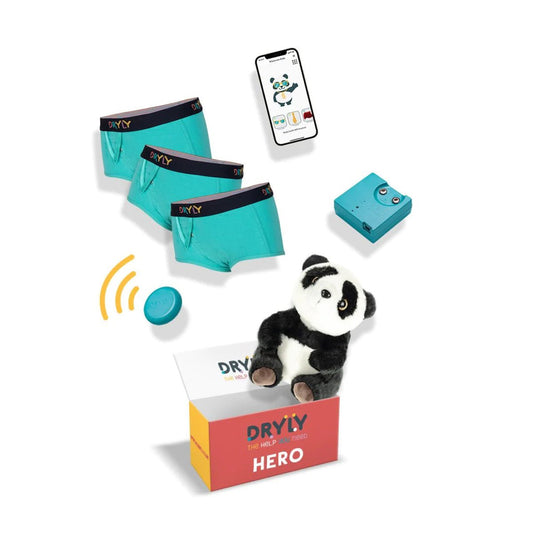
Dryly® Bedwetting Alarm Hero
Normal price CHF 269.00Offer price CHF 269.00Unit Price perMost Popular- Dryly® App
- Optional vibration function
- Sender and Recipient
- Solid-Color Underwear 3 Pack
- Wizzu (Panda Stuffed Animal)
Sale -


Dryly® Bedwetting Alarm Superhero
Normal price CHF 299.00Offer price CHF 299.00Unit Price perBest deal- 4 pairs of underwear (solid color/print)
- Dryly® App
- With a mattress protector
- Optional vibration function
- Sender and Recipient
- Wizzu (Panda Stuffed Animal)
Sale